This post is about the personification of werewolves through different periods in time helping me to pinpoint roughly what visually represented era I would like to base the creation of my monster on. All of which can be cited as (Anonymous, 2011, P. 17-19)
In the 18th century, wolves were an ever-present menace to people living in the European countryside. Now, werewolves seem to be as popular as vampires.
This is a reoccurring topic that keeps cropping up during my research, whether it just be for the sake of comparison or to slate this generations perceptions or in rare cases to praise it. This battlefield of opinion allows me to see the positives and negatives of both sides which thus helps me to narrow down my visual representation of the possibilities of my monsters.
The following three extracts help give a more detailed analysis of the development of Werewolves through time in the eyes of its varied generations.
You don't want to know what lurks in the shadows.
It was March 1765 in the French countryside. A boy named François and his older sister were walking down a road, when suddenly, a strange beast sprang from the shadows. Francois's sister screamed in horror as the beast attacked her little brother. By the time help arrived, the boy was dead, his body mutilated.Nobody but the traumatized sister witnessed the crime. But villagers had no doubt what - or who - so savagely murdered François. It wasn't an animal. It wasn't a human. It was a werewolf.
Why being a werewolf is sort of awesome.
So it isn't exactly convenient to sprout claws, fangs, and facial hair every time there is a full moon. But for teen Scott McCaIl, becoming a werewolf was just about the greatest thing that ever happened to him. It cured his asthma, helped him get a date with the girl of his dreams, and turned him into a star player on the school lacrosse team. It also gave him some seriously awesome biceps.
I couldn't agree more when the text later goes on to state that Werewolves have joined vampires as entertainment superstars. This specific sentence is going to be in the back of my mind as I look to creating my monster as this is exactly what I want to avoid. I want to go back to the days when such beasts were feared and not idolised, when it was seen as a curse and not a cheat to life. As is clearly represent from the opposing texts above.
Sunday, 4 November 2012

Research: The Representation of Werewolves in the 18th Century
Throughout this century there has been a building awareness of werewolves which has been sparked or been spread with the help of fairytales and heresay. The one that stood out to me the most happened at the end of the century. I feel like I can use this to help base when I would set my scene...
1795 F - A Meteor strikes near Wold Newton in Yorkshire, England on December 13, 1795, resulting in a series of benevolent mutations in the bloodlines of those present. Among the affected is Louis Lupin, a coachman and latent lycanthrope. (This factual meteor has been used as the entire basis for the "Wold Newton Universe" concept first popularized by author Philip José Farmer in Tarzan Alive and Doc Savage: His Apocalyptic Life. Further, Jean-Marc Lofficier has expanded upon the effect this had on the Lupin line in his article The Conspiracy.)
- Grigori Russoff is inflicted with lycanthropy while defending his wife Louisa from Dracula. The Russoff family bears the curse, even though Grigori's children had already been born at the time of the attack. [WEREWOLF BY NIGHT, Marvel Comics] (Please note that this report has been placed into dispute by recent sources suggesting that the Russoff lineage does not possess lycanthropy at all, and only the adoption of John Lawrence Talbot by Baron Ivor Russoff in the 1940s connects them. See later entries on this timeline, taken from Chuck Loridan's MONSTAAH timeline, for this Wold Newton interpretation.)
http://www.therianthropes.com/were_fiction_timeline.htm
A few good key points from this text is that it involves other mythical beings such as Dracula, also the fact that they tell you that it may all be false only makes you think it could be more true. I can use this idea for my main synopsis. Whereby the main character doesn't want to believe even though all the signs are telling her too. Also I like the term "Lycanthorpe" which is what the Werewolves are called in Underworld. I feel that I might bring it in once or twice in the story but it feels to old school traditional for my film, perhaps it can be used when the main character is given a history about the beasts that killed her father.
Academic Research: Werewolf Origin
Based on my previous research posts, namely where I decided to make a film within the fantasy horror genre, I have concluded that the best thing to do would be to set my film sequence in the past. I have decided to go with the 1700's as I feel that the look will be adequate in terms of fashion and the naivety of the times. Creating an effective juxtaposition between the monsters of the night and the monsters of society.

Before I can pin down the story it's important to get some back-story on my monsters. Where they came from and the general response they caused in their unsuspecting victims.
Poems and Quotes from literary texts...
In Poetry one of the first mentions of Werewolves was in Ovids Metamorphoses
"He himself ran in terror, and reaching the silent fields howled aloud, frustrated of speech. Foaming at the mouth, and greedy as ever for killing, he turned against the sheep, still delighting in blood. His clothes became bristling hair, his arms became legs. He was a wolf, but kept some vestige of his former shape." - Book I:199-243. Translation by A.S. Kline.
http://classics.mit.edu/Ovid/metam.html
This poem written in the times of the Romans around 17 or 18 BC crushes all notions of Werewolves being existent from the 1500's. It does though give a depiction of what a werewolf can look like... Keeping its human shape as it became a beast.
Pictures showing the visuals of stories as well as early sightings in history...


This has given me a better idea in terms of characteristics how I should portray the Werewolf I intend to create for my piece. Mean and unforgiving, raw and savagely.

Before I can pin down the story it's important to get some back-story on my monsters. Where they came from and the general response they caused in their unsuspecting victims.
Poems and Quotes from literary texts...
In Poetry one of the first mentions of Werewolves was in Ovids Metamorphoses
"He himself ran in terror, and reaching the silent fields howled aloud, frustrated of speech. Foaming at the mouth, and greedy as ever for killing, he turned against the sheep, still delighting in blood. His clothes became bristling hair, his arms became legs. He was a wolf, but kept some vestige of his former shape." - Book I:199-243. Translation by A.S. Kline.
http://classics.mit.edu/Ovid/metam.html
This poem written in the times of the Romans around 17 or 18 BC crushes all notions of Werewolves being existent from the 1500's. It does though give a depiction of what a werewolf can look like... Keeping its human shape as it became a beast.
Pictures showing the visuals of stories as well as early sightings in history...

Vergilius Solis (1514-1562)

Brooks Nathan, Metamorphosen, 1849
18th Century engravings of Werewolves.....

Saturday, 3 November 2012
Research: Werewolves In Television
After my research into the look of Werewolves in Film I have decided to look at Werewolves in Television for budgetary reasons. I figured the way they portrya werewolves has to be done in the most cost effective way as with Television as we know there isn't just a one off episode like a film, they have to consider the budget in terms of a whole season and then again as an episode. Televisions shows that I watch/have watched that are based in the supernatural/fantasy genre that also include a regular element of Werewolf-ery include....
 The Vampire Diaries (2009-Present)
Werewolf: Michael Trevino
Though once in fully transformed the Werewolves in TVD are real wolves with contact lenses, the transition phase shows interesting details. The eyes, the veins and the teeth. Making me realise something I never considered. Changing into a beast can't be all that pain free.

Werewolf: Seth Green
They have chosen to use facial hair, teeth and this time demon clad eyes to represent a werewolf still in half human mode. The black eyes make him more creepy, I think the facial hair looks messy and isn't giving off the right vibe to the audience as it almost contradicts the spooky eyes.

Teen Wolf (2011-Present)
Werewolf: Tyler Posey
It is interesting to see the journey this character has gone through as the Teen Wolf series is based on the
Michael J Fox 1985 movie. This is Scott Mcall in full Were mode. Note the Pointed and hairy ears and overgrown sideburns. The elongates eyebrows that get lost in the protruding nose. Naturally we have the headlight eyes and the teeth. Its good to see though that they've only chosen the canines to elongate.

Supernatural (2005-Present)
Werewolf: Emmanuelle Vaugier
I thought it would be nice to see a female representation of a werewolf as statistically speaking there are more males in the clans.
Again the main feature change will be the eye; this time sparkling blue which I think almost works better than being Yellow or Black, it makes them almost seem human. The teeth of course is another highlighted factor, another thing I have picked up on in the messy hair that all werewolves seem to pick up in transformation. A minor but effective detail.
In comparison with my post on the depiction of werewolves in film where they seem to skip the process between man and beast television series do the opposite. The characters spend half their time in the inbetween, or in some cases what seems to be the inbetween is actually full transition mode.
This is a good idea as it still allows the actor to be visible, coherent and enables me to pick key facial parts I can use to give my own monster it's own unique look.
As well as this looking at how the idea of Werewolves have changed over the years especially in terms of Teen Wolf, the 1985 and Modern versions it's as if less is more in terms of the scare factor. Or perhaps our generation are so used to the characteristics associated with the supernatural that creators no longer need to go over the top. Vampires no longer wear cape and white shirts, Witches no longer have warts and a broom sticks and werewolves don't need to be covered head to toe in fur.
Thursday, 1 November 2012
Research: Werewolves In Film
As seen from my previous posts I was leaning towards making a movie of the fantasy Horror genre. A world that knows things that go bump in the night do exist. The only thing that was left to decide is what creature to recreate within the film and the sequence in particular. I have chosen to go with werewolves for a number of reasons. It will allow an aspect of creative freedom when I design my monster, whereas with something like a Vampire that isn't much that you can change in terms of what we know about them; The only manipulation to be had would be with their eyes and mouth, nothing the audience won't expect. With a werewolf on the other hand there are so many interpretations of what they look like and what they're shape-shifting abilities are that it allows some leeway into creating something unique.
 Teen Wolf (1985)
D: Rod Daniel
Werewolf: Michael J Fox
In this movie Scott Howard one day transforms into a werewolf, because of a hereditary defect in his family. This film is classed as a Family Comedy. Explaining why the werewolf looks more like a giant friendly monkey than anything to be scared of.
 Twilight Saga; New Moon (2009)
D: Chris Weitz
Werewolf: CGI
In a town already over populated with Vampires a Werewolf infestation also takes place. We see the character in human form a lot so there's an emotional attachment. It wouldn't make sense to make the transformed state something to be scared of, thus we end up with an oversized semi aggressive dog.
 Van Helsing (2004)
D: Stephen Sommers
Werewolf: CGI
Though the werewolves depicted in this action horror movie or CGI it gives a different variation from the previous two. Almost a cross between the two. Obviously more fearful and more in the direction of something I'm looking for. An Unshaven Wrestler in a Halloween mask.
Other Werewolves in Film seem to be all done with CGI....
 Underworld (2003)
D: Len Wiseman
Frostbitten Werewolf
 Harry Potter and The Prisoner Of Azkaban (2004)
D: Alfonso Cuaron
Starved Hyena Hybrid Werewolf
.........I unfortunately don't have that luxury. Films are big budget so the monsters they create only have to be around for a short while, but if you wanted to create a monster in Television then you have to be more careful with how much CGI you use not only for budgetary reasons but so believability in the long term with your audience. That I think that is where I need to get my inspiration from.

D: Rod Daniel
Werewolf: Michael J Fox
In this movie Scott Howard one day transforms into a werewolf, because of a hereditary defect in his family. This film is classed as a Family Comedy. Explaining why the werewolf looks more like a giant friendly monkey than anything to be scared of.
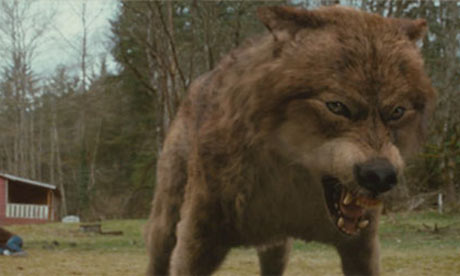
D: Chris Weitz
Werewolf: CGI
In a town already over populated with Vampires a Werewolf infestation also takes place. We see the character in human form a lot so there's an emotional attachment. It wouldn't make sense to make the transformed state something to be scared of, thus we end up with an oversized semi aggressive dog.
D: Stephen Sommers
Werewolf: CGI
Though the werewolves depicted in this action horror movie or CGI it gives a different variation from the previous two. Almost a cross between the two. Obviously more fearful and more in the direction of something I'm looking for. An Unshaven Wrestler in a Halloween mask.
Other Werewolves in Film seem to be all done with CGI....

D: Len Wiseman
Frostbitten Werewolf

D: Alfonso Cuaron
Starved Hyena Hybrid Werewolf
.........I unfortunately don't have that luxury. Films are big budget so the monsters they create only have to be around for a short while, but if you wanted to create a monster in Television then you have to be more careful with how much CGI you use not only for budgetary reasons but so believability in the long term with your audience. That I think that is where I need to get my inspiration from.
Wednesday, 31 October 2012
Academic Research: Things That Go Bump In The Night
Whilst deciding upon the monster that I wanted to create I came upon this quote; Either way, the attraction of horror derives from its appeal to the 'beast' concealed within the superficially civilized human. (Tudor, 2010, p.48)
This quote got me thinking about the kinds of monsters that this generation has become unfazed by, this ranges from Bigfoot on Harry and The Hendersons (William Dear, 1987) to the more obvious Twilight franchise. Bigfoot acted humane and thus this legendary beast became a loveable household character and the same can be said for the so called monsters in the Twilight franchise.

I aim to make my monster someone to be reckoned with and what can be derived from the quote by Tudor is that; if I was to look at creating a beast that is despicable in its's human form it would garter no sympathy from the audience in it's monstrous form. Thus giving the monster back its power to hold fear over the audience.
The chapter goes on further to say; Along with narrative tension, which is an expectation audiences have of every kind of horror movie, horror fans also clearly expect monstrosity, though in quite what form is open to question. The genre encompasses everything from monsters present only by suggestion or inference through to graphic portrayals of monstrous creatures and the excesses of their depredations, while audience responses run the gamut from repulsion through ambivalent
fascination and on to self-conscious, knowing humour. (Tudor, 2010, p.50)
My interpretation of this text is that the way I choose to express my monster, whether it be going full on "oldschool" by which I mean adding in every detail down to a T. To "New Age" suggestive hints of the beast whereby less is more, it will have a different effect on different members of the audience because though they may all be fans of the horror genre they have different specifications to what that entails and there's no way to gauge such a thing. Therefore I should go about creating whatever beast I feel most comfortable with as there is no way it will please every watcher.
Sunday, 28 October 2012
Lesson: Moodboard

My mood-board for our class exercise. This is a visual representation of the elements we want to achieve within the film piece. In a way it gives you a story outline for what will happen. This has been done digitally but it could have also been done physically. Getting pictures or swatches of material and visual links such as I have been done above. Though it is used a lot by Art Directors when they are trying to create a feel for the characters that they are styling this can also be used by other departments for them to depict to others the look or feel they are trying to get across in their field. The plus side about making a physical mood-board is that you can move things around, and easily add other elements.
Subscribe to:
Posts (Atom)